

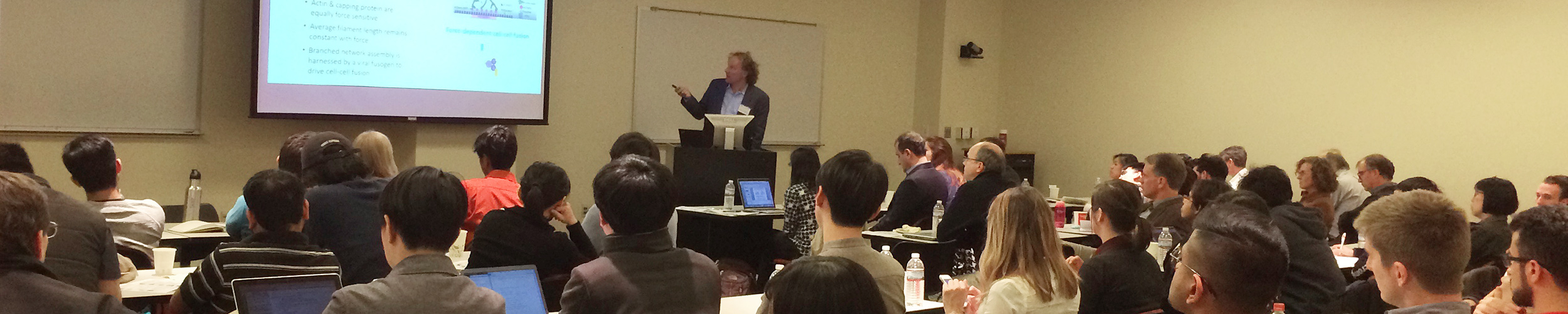
Ajay Gopinathan

Collective phases, instabilities and function in chemotactic cell clusters
Abstract:
Migrating clusters of cells are known to mediate important physiological processes such as embryonic development, wound healing, and cancer metastasis. The collective, coordinated motion of cells allows for emergent behaviors unavailable to single cells that are critical for proper function. In this talk, I shall describe our work on modeling such behaviors in malignant lymphocyte cell clusters migrating in a chemokine gradient – a process contributing to metastasis. Our simulations highlight how frustration can arise at the group level due to heterogeneity in behavior among individual cells in the cluster. Resolution of this frustration can lead to new collective phases of motion including transient rotations, chemotactically driven instabilities and even cluster size-dependent reversals in migration direction. We observed these novel phases in in vitro chemotaxis assays of lymphocyte clusters and obtained good quantitative agreement with our predictions. Finally, we discuss how these phases could be functionally important in vivo – enabling robust chemotaxis, cluster size regulation and “load sharing” among cells.
[1] Copenhagen et al, Science Advances (2018)
[2] Sanoria et al, PRX Life (2026)
Speaker: Ajay Gopinathan, University of California Merced
Ajay Gopinathan is a Professor of Physics, Director of the NIH Interdisciplinary Biological Science and Technology Graduate Training (T32) Program, and Co-Director of the NSF-CREST Center for Cellular and Biomolecular Machines (CCBM) at the University of California, Merced. He also serves as Past Chair of the Division of Biological Physics of the American Physical Society. He received his Integrated M.Sc from the Indian Institute of Technology Kanpur, his Ph.D. from the University of Chicago and following postdoctoral research at UCLA and UCSB, he joined UC Merced in 2006 as one of the first Physics faculty at the new campus. His current research involves using theory and computation to understand biological processes such as the movement of material inside cells, viral assembly and transport, regulation of cell shape, and the collective migration of cells. Honors include a 21st Century Science Initiative Scholar Award from the James S. McDonnell Foundation and being elected a Fellow of the American Physical Society.
Host: Arpita Upadhyaya
Seminars start at 4:00 pm, and refreshments will be served at 3:45 pm. All seminars are held in the 2136 Physical Sciences Complex (#415) unless otherwise noted.