

Leon Kaub
Magnetic nanoparticles and iron homeostasis: from stem cells to brain tissue
Abstract:
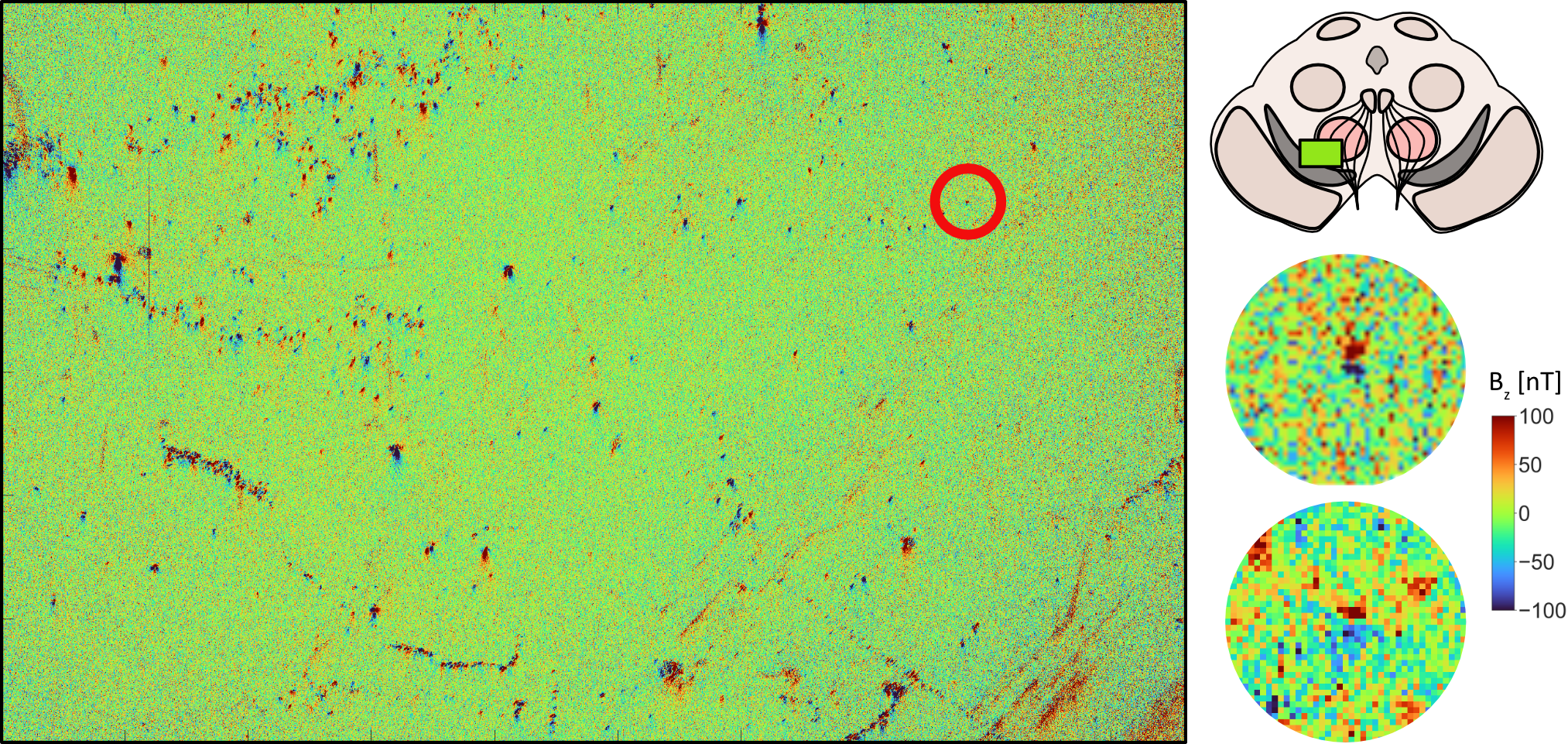
Iron accumulates in specific brain regions during aging and in neurodegenerative disorders such as Alzheimer's and Parkinson's disease, yet the form of this excess iron and how cells cope with it are incompletely understood. The human brain also contains magnetic iron oxide nanoparticles, but their origin and potential role in iron homeostasis remain unclear. Are they taken up from the environment or produced by our own cells? Our magnetic measurements of human brain tissue point to a possible link between brain magnetite and liver disease and reveal an age-dependent trend in magnetic properties that may reflect changes in particle size. However, a better understanding of these particles requires going beyond bulk measurements to determine where they are located within tissue. Nitrogen-vacancy (NV) magnetometry provides a way to probe magnetism at the single-particle scale. We use wide-field NV imaging to detect individual magnetic particles in tissue and scanning NV magnetometry to study magnetotactic bacteria, nature's best-understood magnetite producers, with nanoscale resolution. To explore whether human cells can also produce magnetic particles, we turn to stem cells in culture. We find that they not only degrade synthetic iron oxide nanoparticles but subsequently form new magnetic particles from the released iron. Remarkably, a nanoparticle precursor is not required: cells supplied with iron salts alone can also form magnetic structures. Despite high intracellular iron loads, the cells do not necessarily undergo ferroptotic cell death. Instead, our results suggest that they mineralize excess iron and export it in extracellular vesicles. Such a mechanism could help explain how cells in the aging or diseased brain cope with accumulating iron, and where the magnetic nanoparticles in our brains originate from.
Speaker: Leon Kaub, Institut Curie
Leon is a postdoctoral researcher at the Institut Curie in Paris, where he studies how human cells process magnetic nanoparticles, particularly how stem cells biomineralize their own superparamagnetic iron oxide particles. His research centers on naturally occurring magnetic nanoparticles across a wide range of organisms, from magnetotactic bacteria and magnetic protists to humans. To study these particles, he combines SQUID magnetometry of bulk samples with nitrogen-vacancy (NV) quantum diamond microscopy, which enables imaging of individual magnetic particles directly in cells and tissue. He studied physics and geophysics at the Ludwig-Maximilians-University of Munich, Germany, where he earned his Ph.D. for research on magnetite nanoparticles in the human brain through a collaboration between geophysics and neuroanatomy. His recent discovery of magnetite-biomineralizing bacteria living as endosymbionts inside a ciliate, published in PNAS, suggests that iron oxide biomineralization may be more widespread across the tree of life than previously thought.
Host: Wolfgang Losert
Seminars start at 4:00 pm, and refreshments will be served at 3:45 pm. All seminars are held in the 2136 Physical Sciences Complex (#415) unless otherwise noted.