ChemPhys Logo 1
ChemPhys Logo 2

  • About
    • About the Program
    • CHPH Events Calendar
    • Doctoral Defenses
    • Campus
    • Contact Us
  • People
  • Prospective Students
    • Virtual Open House
    • Overview
    • Application Process
    • Financial Support
    • Curriculum
      • Other Courses of Interest
    • FAQ
  • Current Students
    • New Student Checklist
    • Requirements & Policies
    • Forms & Procedures
    • Advising & Mentoring
    • FAQ
  • Research
    • Research Areas
      • Theoretical
      • Experimental
    • Collaborations
      • NIST
      • NIH
      • JQI
  • News

News

Breadcrumb

  1. IPST Home -
  2. Graduate Programs -
  3. Chemical Physics -
  4. News
  • Actin filaments
    NCI-UMD Partnership Ph.D. Student Aravind Chandrasekaran Publishes First-author Paper in PLoS Computational Biology
    IPST, Biophysics, Chemical Physics, NCI-UMD Partnership, Physics of Living Systems- 09 Jul 19

    Aravind Chandrasekaran, a chemistry Ph.D. student in the NCI-UMD Partnership program, published a first-author paper "Remarkable structural transformations of actin bundles are driven by their initial polarity, motor activity, crosslinking, and filament treadmilling" with co-authors Arpita Upadhyaya (Physics/IPST) and Garegin Papoian (Chemistry and Biochemistry/IPST). The paper was published on July 9, 2019, in the journal PLoS Computational Biology.

  • Wolfgang Losert
    Wolfgang Losert Named Interim Director of IPST
    IPST, Chemical Physics- 01 Jul 19

    Professor Wolfgang Losert was appointed interim director of IPST, effective July 1, 2019.
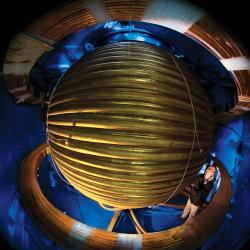
  • Dan Lathrop with a geodynamo
    IPST and Physics Professor Daniel Lathrop named 2019 Distinguished Scholar-Teacher
    IPST, Chemical Physics- 28 Jun 19

    Professor Daniel Lathrop (IPST / Physics) has been named a 2019 Distinguished Scholar-Teacher.
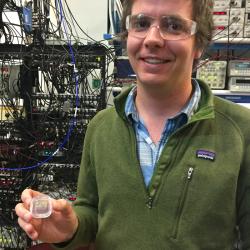
  • Samuel Brewer
    Chemical Physics Alumnus Featured in Physics World: Entangled Aluminum Ion is World’s Best Timekeeper
    Chemical Physics- 12 Jun 19

    Samuel M. Brewer (Ph.D. '12, Chemical Physics) was featured in Physics World on June 6, 2019. A member of NIST’s Ion Storage Group, Brewer built a quantum-logic clock using a positive ion of aluminum-27 as its timekeeper. The group, located in Boulder, Colorado, conducts experiments on atomic ions that are confined in electromagnetic traps and laser-cooled, in some cases, to the ground state of motion.
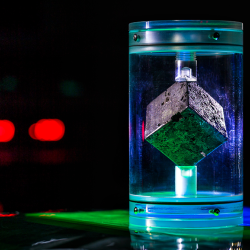
  • uranium cube
    Have You Seen this Cube?
    Chemical Physics- 30 Apr 19

    A very rare piece of atomic history—a mysterious block of uranium metal—landed on the desk of Tim Koeth in 2013.

    So marks the beginning of a years-long investigation into the many secrets of the two-inch square cube, and the intriguing note that came with it: Taken from the reactor that Hitler tried to build. Gift of Ninninger.

    “I was stunned. I didn’t have words,” recalls Koeth, an associate research professor with the University of Maryland’s Department of Materials Science and Engineering and Institute for Research in Electronics and Applied Physics.

  • Chemical Physics Ph.D. Student Brandon Wilfong Co-authors Paper in Applied Physics Letters
    Chemical Physics- 30 Apr 19

    Chemical Physics Ph.D. Student Brandon Wilfong co-authored the paper "Magnetic order effects on the electronic structure of KMMnS2(M=Cu,Li) with the ThCr2Si2-type structure" with Efrain Rodriguez, associate professor of chemistry and biochemistry. The paper was published in the journal Physical Review Materials on April 30, 2019. 
  • Chaos
    Our Fearless Idea Controlled Chaos
    IPST, Chemical Physics, Physics of Living Systems- 26 Apr 19

    The College of Computer, Mathematical, and Natural Sciences has always been driven by fearless science. Reaching back more than a half-century, the college highlighted some of the most exciting scientific discoveries made by its faculty members. One of those discoveries was Distinguished University Professor James Yorke's (Math/Physics/IPST) and Edward Ott (ECE/Physics/IREAP) co-authored paper in 1990 that described a method for stabilizing a chaotic system. By adjusting a carefully chosen parameter, the researchers showed that they could prod the system toward a desired outcome. 

  • supercell storm
    My Fearless Idea Confirmed Storms Spread Pollution
    Chemical Physics- 25 Apr 19

    The College of Computer, Mathematical, and Natural Sciences has always been driven by fearless science. Reaching back more than a half-century, the college highlighted some of the most exciting scientific discoveries made by its faculty members. One of those discoveries was from Russell Dickerson, currently a professor of atmospheric and oceanic science at UMD.
  • Wood-based Technology Creates Electricity from Heat
    Wood-based Technology Creates Electricity from Heat
    Chemical Physics- 08 Apr 19

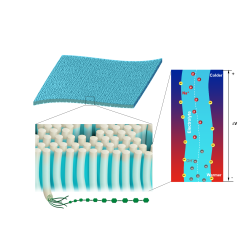
    Researchers at the University of Maryland have created a heat-to-electricity device that runs on ions that could someday harness the body’s heat to provide energy.

  • Electron avalanche
    Radioactive Material Detected Remotely Using Laser-induced Electron Avalanche Breakdown
    Chemical Physics- 22 Mar 19

    University of Maryland researchers led by Howard Milchberg developed a powerful new method to detect radioactive material. By using an infrared laser beam to induce a phenomenon known as an electron avalanche breakdown near the material, the new technique is able to detect shielded material from a distance. The method improves upon current technologies that require close proximity to the radioactive material.

Pagination

  • First page « First
  • Previous page ‹ Previous
  • Page 1
  • Page 2
  • Current page 3
  • Page 4
  • Page 5
  • Next page Next ›
  • Last page Last »

CMNS CSCAMM Logo

CMNS CSCAMM Logo


Connect with
Chemical Physics

Links

  • About Chemical Physics
  • UMD Home
  • Privacy Notice
  • Web Accessibility
  • Login

Contact Chemical Physics

  • Mailing Address:
    8108 Regents Drive (Building #085), Room 2123
    College Park, MD 20742-2431
  • Phone: 301-405-9307
  • chemphysics@umd.edu
  • Directions to the IPST Bldg (#085)