
Reconstructing the evolution of signaling networks for premalignant oral lesions and their transformed squamous cell carcinomas from single-cell spatial transcriptome sequencing
PRINCIPAL INVESTIGATORS:
Erin Molloy, Department of Computer Science, University of Maryland
Joe Nguyen, Head and Neck Cancer Section of Surgical Oncology Branch Program, Center for Cancer Research, National Cancer Institute
PH.D. STUDENT:
Wenshan Wu, Computer Science, University of Maryland
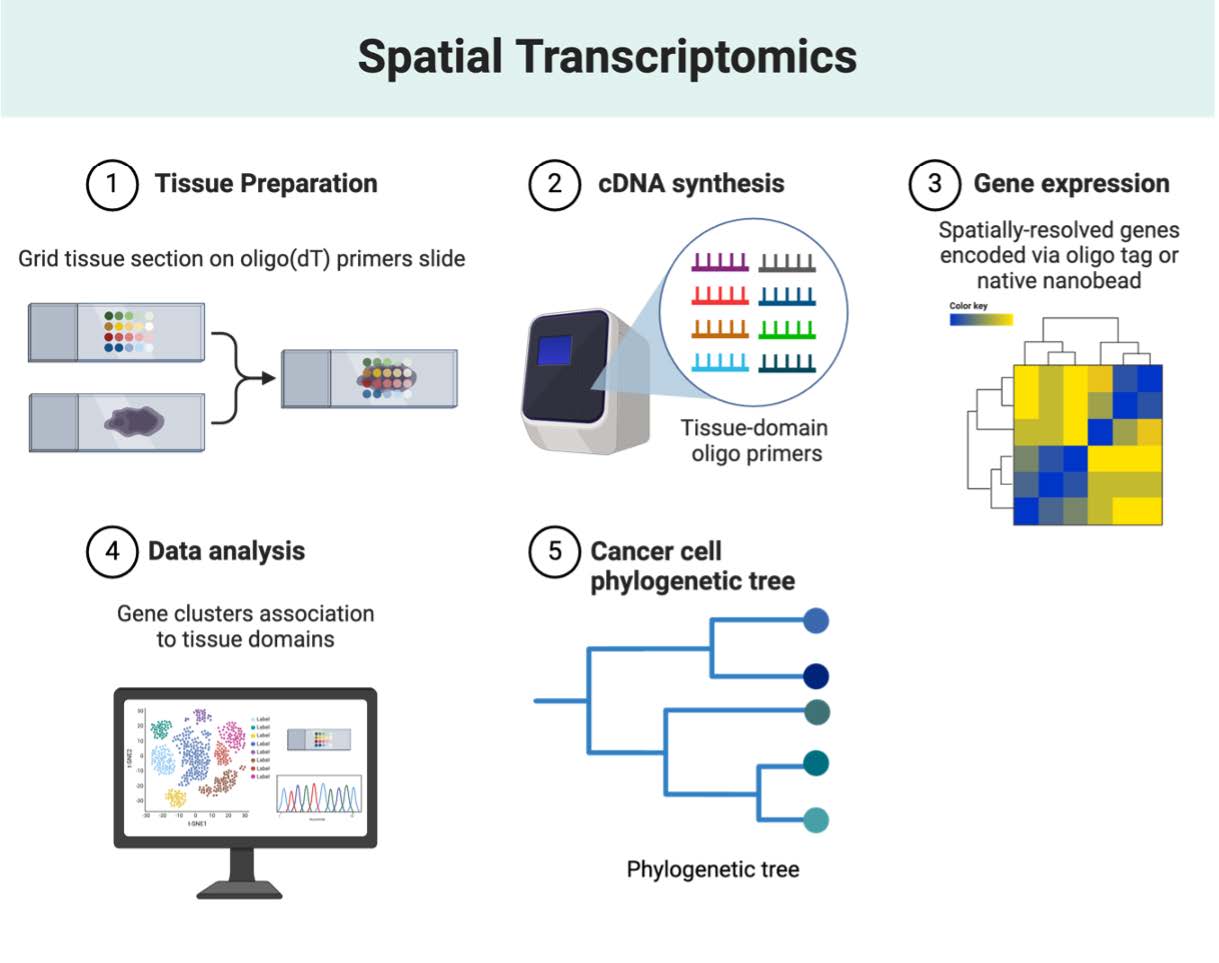
Head and neck cancer is the sixth most common cancer worldwide, yet the five-year survival rates have seen little improvement over the past decade. A significant obstacle in improving patient outcomes is our limited understanding of how cancer develops from precancerous oral lesions. This project will bridge this critical knowledge gap by applying cutting-edge spatial transcriptome sequencing technologies to premalignant oral biopsies (and their patient-paired transformed squamous cell carcinomas) as well as developing the computational methods needed to analyze these data; thus combining the clinical and experimental expertise at NCI/Nguyen Lab with the computer science and comparative genomics expertise at UMD/Molloy Lab. The algorithms/software developed in this project will incorporate deep learning and statistical phylogenetics to address the unique challenges of reconstructing the evolution of cell signaling pathways from longitudinal spatial transcriptomic data, along with tools for comparative analytics; the successful completion of this project will mark a critical step towards identifying targets for early therapeutic interventions in head and neck cancer.
Niche-in-a-Dish Platform for Quantitatively Analyzing the Role of Stromal Components on
Disseminated Tumor Progression
PRINCIPAL INVESTIGATORS:
Kimberly Stroka, Fischell Department of Engineering, University of Maryland
Meera Murgai, Center for Cancer Research, National Cancer Institute
PH.D. STUDENT:
Nikka Givpoor, Fischell Department of Engineering, University of Maryland
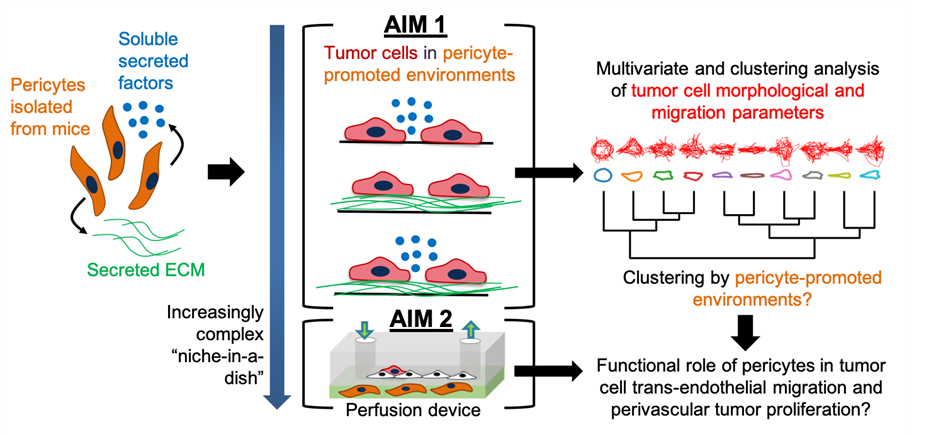
Successful colonization of metastatic tumor cells at a distant site is strongly influenced by specific environmental signals (e.g., other cells, biochemical factors, or mechanical cues) that are present in those sites; however, the contribution of stromal cells (e.g., pericytes) to the formation of pre-metastatic niches, and to what degree they serve a functional role in metastatic outgrowth is unknown. The proposed work will explore the hypothesis that pericyte-derived ECM and soluble secreted factors quantitatively shift tumor cell morphological and migration phenotypes in a niche-in-a-dish device and promote metastatic progression in vivo. To explore this hypothesis, we propose two aims: (1) Develop a quantitative understanding of how pericyte-promoted environments alter tumor cell migration phenotypes in a high throughput platform in vitro; and (2) Engineer a “niche-in-a-dish” device that mimics aspects of the pericyte/vascular interface and enables modeling of tumor cell trans-endothelial migration and motility and growth in the perivascular space. The impact of this work will be a more complete understanding of the effects of pericytes in the pre-metastatic niche, which will elucidate the potential for new therapeutic approaches targeting stromal cell components, such as pericytes.