CHPH Graduate Smrithan Ravichandran Receives 2026 APS Carl E. Anderson Dissertation Award
CHPH Graduate Smrithan Ravichandran Receives 2026 APS Carl E. Anderson
Dissertation Award
Dr. Smrithan Ravichandran, a former graduate student in the University of Maryland’s Chemical Physics Program (CHPH), has received the 2026 Carl E. Anderson Dissertation Award from the American Physical Society’s Division of Laser Science (DLS). The award recognizes an outstanding doctoral dissertation in laser science and honors Ravichandran’s contributions to the development of experimental approaches for advancing studies of nonlinear quantum electrodynamics (QED) with high-intensity lasers.
Ravichandran earned his Bachelor of Technology in Engineering from the Indian Institute of Technology Madras (IIT Madras, Chennai, India) in 2020 before joining the University of Maryland, where he pursued his Ph.D. under the guidance of Wendell Hill, professor and director of the Institute for Physical Science and Technology (IPST). He is currently a postdoctoral researcher at the University of Rochester’s Laboratory for Laser Energetics (LLE).
“This award means a lot to me. As an undergrad, I used to read about the APS dissertation awards in awe, especially because many past recipients went on to become internationally renowned scientists. I thought it would be super cool to even hypothetically be a finalist because I never imagined I could be part of the list of recipients, so it feels surreal that it actually
happened.”- Smrithan Ravichandran
Multi-petawatt lasers provide an unprecedented experimental platform for testing predictions of nonlinear quantum electrodynamics, in which the interaction of light and matter becomes strongly nonlinear under extremely intense electromagnetic fields. Realizing precision
measurements of nonlinear QED effects, however, requires overcoming significant challenges in controlling and characterizing the laser focus. Ravichandran’s doctoral research addressed two critical challenges: characterizing the focal volume in real time at full laser power and minimizing the presence of real particles within the focal volume.
His dissertation demonstrated an approach based on the dynamics of electrons liberated from residual gas molecules in the laser focal region. When exposed to an intense laser field, these electrons can be expelled from the focal volume at acute angles relative to the direction of laser propagation. Through experiments and numerical simulations, Ravichandran showed that the spatial distribution of these ejected electrons contains information about the laser focus,
including its peak intensity and aberrations, as well as the presence of potentially deleterious particles. This approach provides a potential pathway toward real-time characterization of the extreme conditions required for precision measurements of nonlinear QED effects. Such measurements could enable experimental tests of theoretical predictions that have remained difficult to access with existing laser-based techniques.
“I am so pleased that my former graduate student, Smrithan Ravichandran, has been honored with the 2026 Carl E. Anderson Dissertation Award from the Division of Laser Science (DLS) of the American Physical Society (APS). This award acknowledges the hard work and long hours he put into his studies and research projects, which allowed him to write an outstanding Ph.D.
thesis. As a student, he was a quick learner, deep thinker and very teachable, all of which were instrumental in him learning to think and communicate like a scientist. In addition, he was extremely productive and talented in the lab, a skilled teacher and compassionate, making him just a good human being. I look forward to watching him mature into a first-rate scientist and
wish him all the best during his tenure as a postdoc at the Laboratory for Laser Energetics at the University of Rochester. Congratulations Smrithan, well deserved.” -Wendell Hill
Ravichandran credits several aspects of his experience in the CHPH program with helping him develop the research and communication skills that contributed to his success: “There are several factors that played a big role. The earliest would be having a lab rotation as part of the curriculum, which is a major benefit that allowed me to explore different research environments without the pressure of committing to a group. Then, the training I received from my advisor on how to present my work, coupled with opportunities at UMD like the three-minute thesis competition, was extremely helpful in improving my communication skills.”
He also emphasized the importance of mentorship and encouragement from his doctoral advisor: “Beyond these structured learning opportunities, my Ph.D. advisor's support was key. There were multiple occasions, some during very trying times, when he would try to boost my confidence by reminding me that he hoped to eventually nominate me for an APS dissertation award. Hearing this started making me believe I could actually achieve it and gave me the confidence I needed to make it happen.”
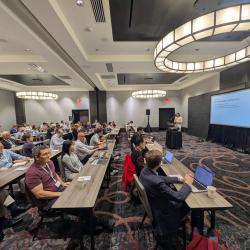
During his time at UMD, Ravichandran also demonstrated his ability to communicate complex scientific ideas to broad audiences. His presentation, “Harnessing Powerful Lasers to Help Build a Fish Tank of the Universe,” was selected as the winner of UMD’s Three Minute Thesis (3MT) video competition in 2025. The presentation introduced the scientific motivation behind his research and connected his work to fundamental questions about matter and light under extreme conditions.
Ravichandran has continued his research in high-intensity laser science as a postdoctoral researcher at the University of Rochester’s Laboratory for Laser Energetics, one of the leading centers for research involving high-energy-density physics and intense laser systems.
The CHPH community congratulates Dr. Ravichandran on receiving the 2026 Carl E. Anderson Dissertation Award and celebrates this outstanding recognition of his doctoral research and accomplishments.
About the Chemical Physics Program
The University of Maryland’s Chemical Physics Program (CHPH) is an interdisciplinary graduate program that brings together faculty and students from across the physical sciences to investigate fundamental problems at the interface of physics, chemistry, materials science, quantum science and engineering, artificial intelligence and related fields. The program provides students with broad interdisciplinary training while allowing them to pursue specialized research with faculty across the University.